


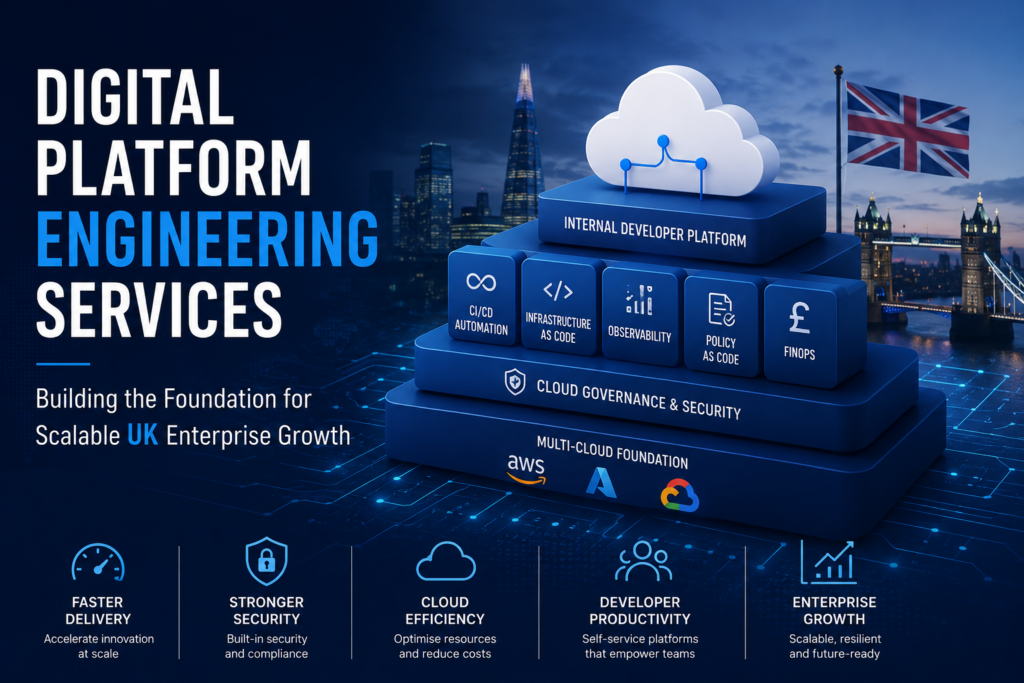
UK organisations are under increasing pressure to deliver digital products faster while maintaining security, compliance, operational efficiency and cost control.
Many enterprises have invested heavily in cloud migration, DevOps initiatives and modern application development. Yet they continue to face challenges such as fragmented tooling, inconsistent deployment practices, rising cloud expenditure, governance gaps and developer bottlenecks.
This is where digital platform engineering services are creating measurable business value.
Rather than focusing solely on application delivery, platform engineering establishes a standardised, self-service technology foundation that enables development teams to build, deploy and operate software efficiently at scale.
For UK organisations navigating GDPR obligations, cloud governance requirements and growing digital transformation demands, platform engineering has become a strategic capability rather than a technical enhancement.
Table of Contents
The State of Platform Engineering in UK Enterprises
Platform engineering has emerged as one of the most significant shifts in enterprise technology operations.
As organisations expand their cloud estates across AWS, Microsoft Azure and Google Cloud, operational complexity increases dramatically. Engineering teams often spend excessive time managing infrastructure, troubleshooting environments and maintaining deployment pipelines.
Many UK enterprises are responding by investing in enterprise platform engineering capabilities that standardise processes, automate operations and improve developer productivity.
Common drivers include:
- Accelerating digital transformation programmes
- Managing multi-cloud environments
- Improving engineering efficiency
- Reducing operational overhead
- Strengthening security controls
- Supporting large-scale product delivery
Platform engineering enables organisations to move from fragmented operational models towards repeatable, governed and scalable software delivery frameworks.
Why Traditional DevOps Alone Is No Longer Enough
DevOps transformed software delivery by improving collaboration between development and operations teams.
However, as organisations scale, DevOps practices alone often become difficult to manage consistently.
Challenges frequently include:
- Duplicate tooling across teams
- Inconsistent infrastructure configurations
- Security policy variations
- Manual governance processes
- Cloud cost inefficiencies
- Limited developer self-service
Platform engineering addresses these limitations by creating shared platforms and reusable capabilities that development teams consume as products.
Instead of every team building its own deployment pipelines and infrastructure stacks, platform teams provide standardised services that reduce complexity and improve consistency.
This evolution is driving increased demand for platform engineering consulting across the UK enterprise market.
Core Components of Modern Digital Platform Engineering Services
Successful digital platform engineering services combine multiple disciplines into a unified operating model.
Internal Developer Platforms
An internal developer platform (IDP) provides developers with self-service access to infrastructure, deployment pipelines, environments and operational tools.
Benefits include:
- Faster onboarding
- Reduced manual requests
- Consistent deployment processes
- Improved governance
- Better developer experience
The most effective platforms abstract complexity while maintaining enterprise-grade controls.
Infrastructure as Code
Infrastructure as Code (IaC) enables organisations to manage infrastructure through version-controlled code.
Advantages include:
- Repeatable deployments
- Reduced configuration drift
- Faster provisioning
- Improved auditability
- Enhanced disaster recovery
Tools such as Terraform and OpenTofu have become central to modern cloud infrastructure engineering strategies.
CI/CD Automation
Continuous Integration and Continuous Delivery pipelines automate software build, testing and deployment processes.
Key outcomes include:
- Faster release cycles
- Reduced deployment risk
- Improved software quality
- Increased engineering productivity
Automation eliminates many manual processes that traditionally slow enterprise delivery.
Observability
Modern platforms require comprehensive visibility across applications, infrastructure and services.
Observability solutions provide:
- Real-time monitoring
- Distributed tracing
- Log analytics
- Performance insights
- Incident detection
This visibility enables proactive platform operations and faster issue resolution.
Policy as Code
Policy as Code automates governance requirements across infrastructure and application environments.
Capabilities include:
- Security enforcement
- Compliance validation
- Configuration standards
- Access controls
This approach significantly reduces manual governance overhead.
Cloud Governance
Effective cloud governance ensures cloud environments remain secure, compliant and cost-efficient.
Key areas include:
- Identity management
- Resource controls
- Compliance monitoring
- Risk management
- Cost oversight
For UK organisations handling regulated data, governance is a critical platform engineering component.
FinOps
Cloud spending continues to be a major concern for enterprise leaders.
FinOps practices provide:
- Cost visibility
- Resource optimisation
- Budget controls
- Consumption analytics
- Financial accountability
Platform engineering integrates FinOps directly into operational workflows, helping organisations maximise cloud investments.
How Digital Platform Engineering Services Improve Developer Experience
Developer experience has become a competitive advantage.
When engineers spend significant time navigating infrastructure complexity, productivity suffers.
Platform engineering simplifies development environments by providing:
- Self-service provisioning
- Standardised workflows
- Automated deployments
- Built-in security controls
- Centralised documentation
A strong developer experience reduces cognitive load and allows engineering teams to focus on creating business value.
For organisations competing for technical talent in the UK market, this can significantly improve retention and recruitment outcomes.
Business Benefits for UK Organisations
Faster Releases
Standardised platforms reduce deployment friction and accelerate software delivery.
Teams can move from monthly releases to weekly or even daily deployment cycles.
Reduced Cloud Costs
Cloud optimisation and FinOps practices help identify inefficiencies and eliminate waste.
This often leads to substantial cost reductions across large cloud estates.
Security and Compliance
Platform engineering embeds security controls directly into development workflows.
This supports:
- GDPR compliance
- Data protection requirements
- Audit readiness
- Secure software delivery
Operational Efficiency
Automation reduces repetitive operational tasks and minimises manual intervention.
Engineering teams spend less time maintaining systems and more time delivering innovation.
Improved Scalability
Cloud native platform engineering enables organisations to scale infrastructure and applications efficiently.
This is particularly valuable for businesses experiencing rapid growth.
Better Innovation Velocity
By removing operational barriers, teams can focus on experimentation, product development and customer value creation.
Digital Platform Engineering Services Use Cases Across Industries
Financial Services
Banks and fintech providers require highly secure and compliant delivery environments.
Platform engineering supports:
- Regulatory compliance
- Secure deployment pipelines
- Risk management
- High availability systems
Insurance
Insurance providers are modernising legacy platforms to improve customer experiences and operational efficiency.
Platform modernization initiatives often rely heavily on platform engineering foundations.
Retail and eCommerce
Retail organisations need scalable infrastructure to support seasonal demand fluctuations.
Platform engineering enables:
- Rapid scaling
- Faster feature delivery
- Improved customer experiences
Manufacturing
Manufacturers increasingly depend on connected systems, IoT platforms and data-driven operations.
Platform engineering supports integration, scalability and operational resilience.
Logistics
Supply chain organisations require real-time visibility and reliable digital infrastructure.
Platform engineering helps improve system reliability and operational responsiveness.
Platform Engineering Trends UK Organisations Should Prepare For in 2026 and Beyond
Internal Developer Platforms
IDPs are becoming standard components of modern engineering organisations.
Platform-as-a-Product
Leading enterprises increasingly treat platforms as products with dedicated ownership, roadmaps and user feedback cycles.
AI-Assisted Operations
Artificial intelligence is improving monitoring, incident management and operational decision-making.
Platform Observability
Organisations are investing in deeper visibility across increasingly distributed environments.
Self-Service Infrastructure
Engineering teams expect on-demand access to infrastructure without lengthy approval processes.
Multi-Cloud Management
As cloud adoption matures, unified management across multiple providers will become increasingly important.
How to Choose the Right Digital Platform Engineering Services Partner
Selecting the right partner has a significant impact on long-term platform success.
Evaluation Checklist
Assess potential providers against:
- Platform engineering expertise
- Cloud-native capabilities
- Security and compliance experience
- Industry knowledge
- Delivery methodology
- Governance frameworks
Technical Capabilities
Look for expertise in:
- Kubernetes
- Containers
- Infrastructure as Code
- CI/CD automation
- Observability platforms
- Cloud architecture
Governance Expertise
The partner should understand:
- GDPR requirements
- Security frameworks
- Risk management
- Cloud governance
- FinOps practices
Industry Experience
Experience within your sector helps accelerate implementation and reduce risk.
Cloud-Native Expertise
Modern platforms require strong capabilities across cloud-native architectures, automation and scalability patterns.
Why Azilen’s Digital Platform Engineering Services Stand Out
As a platform engineering company UK enterprises can rely on, Azilen delivers a comprehensive approach to platform transformation.
Key strengths include:
API-First Architecture
API-driven design supports integration, interoperability and future scalability.
Cloud-Native Development
Azilen helps organisations build resilient cloud-native platforms that support long-term growth.
SaaS Enablement
The team enables businesses to accelerate SaaS product development and platform scalability.
Microservices and Containerisation
Modern application architectures improve flexibility, deployment speed and operational resilience.
Performance Optimisation
Continuous performance monitoring and optimisation help maintain platform efficiency.
Governance and Compliance
Azilen integrates governance frameworks, security controls and compliance requirements throughout platform delivery.
Developer Experience Focus
By prioritising developer experience, Azilen helps organisations improve productivity, reduce friction and accelerate innovation.
Explore Azilen’s digital platform engineering services to understand how modern platform foundations can support enterprise growth, operational excellence and digital transformation goals.
Conclusion
Digital transformation success increasingly depends on the strength of the underlying platform.
UK organisations can no longer rely on fragmented infrastructure, inconsistent DevOps practices or manual operational processes. Modern digital platform engineering services provide the foundation required to improve developer productivity, strengthen governance, optimise cloud investments and accelerate innovation.
As platform complexity continues to grow, organisations that invest in platform engineering today will be better positioned to scale securely, deliver products faster and respond more effectively to future market demands.
Building the right platform foundation is no longer an infrastructure decision. It is a strategic business decision.
FAQs
What are digital platform engineering services?
Digital platform engineering services help organisations design, build and manage scalable technology platforms that improve software delivery, developer productivity, governance and operational efficiency.
What is an internal developer platform?
An internal developer platform is a self-service environment that provides developers with standardised tools, infrastructure and deployment capabilities while maintaining governance and security controls.
How is platform engineering different from DevOps?
DevOps focuses on collaboration between development and operations teams. Platform engineering creates reusable platforms and self-service capabilities that enable DevOps practices at scale.
What ROI can organisations expect from platform engineering?
Typical benefits include faster release cycles, reduced cloud costs, improved developer productivity, lower operational overhead and stronger compliance outcomes.
What is cloud native platform engineering?
Cloud native platform engineering focuses on building platforms using containers, Kubernetes, automation, microservices and cloud-native technologies to improve scalability and resilience.
How does platform engineering support GDPR compliance?
Platform engineering embeds governance, security controls, audit capabilities and policy enforcement into development workflows, helping organisations maintain compliance requirements.
What is platform modernisation?
Platform modernisation involves upgrading legacy infrastructure, operational processes and development environments to support modern cloud-native delivery models.
How does platform engineering improve developer productivity?
By automating infrastructure management, standardising workflows and enabling self-service capabilities, platform engineering allows developers to spend more time building products and less time managing operational tasks.