


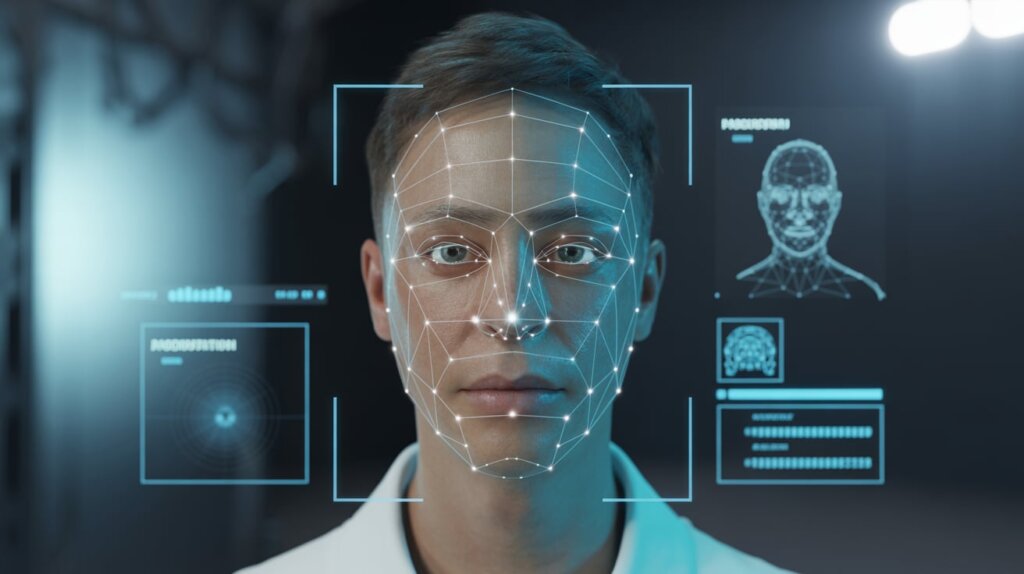
The future of facial recognition is now present as it has quickly become one of the most important technological pillars of today’s digital interactions. Whether it is unlocking smartphones or authentication of people via the internet, it allows machines to identify and acknowledge people using distinctive facial features. Facial recognition is becoming more popular as organizations become digital-first to improve security, manage user processes and minimize fraud. The increasing use of it indicates a more general move to biometric authentication as a more secure alternative to passwords and conventional identity inspections.
Table of Contents
What Is a Facial Recognition and How Does It Work
Facial recognition is a biometric invention which identifies or authenticates an individual based on face features. It starts with capturing the image, which is usually captured using a camera either on a smartphone or a computer. Hi-tech algorithms identify a face in the picture and trace significant features of the nose distances between the eyes, jawline forms, and nose lines. These measurements are translated into a mathematical expression referred to as a facial template. Then, this template is compared to a database of stored templates in order to find a match. This is constantly enhanced by artificial intelligence and machine learning models that become more accurate as the process goes on.
History of the Facial Recognition Systems
Initial facial recognition system was based on rudimentary image-matching and was also restricted to low accuracy and insensitivity to angle and lighting. Nowadays, with deep learning and neural networks, faces are analyzed much more complexly. They are able to identify persons in various settings, facial expressions, and even aging. Reliability has also been improved by the introduction of 3D facial recognition and infrared imaging to complicate the process by which fraudsters can overcome systems with the aid of photos or videos. This development has made facial recognition a scalable and reliable technology that can be applied in reality.
Significant Industries Applications
Facial recognition has become infused in most sectors. It is used to securely onboard users digitally and continue with user authentication in banking and fintech and comply with regulatory standards, including KYC and AML. Facial recognition is applied by retailers to customize the experience of customers and avoid theft. It helps to access the health records of patients securely and eliminate identity mistakes in healthcare. Facial recognition systems are implemented to control the borders, national IDs, and citizen security programs by governments and law enforcement agencies. All these uses underscore the flexibility of the technology and its increasing significance.
Fraud Prevention and Facial Recognition
Facial recognition can be used to fight identity fraud, which makes it one of the most potent advantages. Conventional forms of authentication such as passwords and PINs can be stolen and reused whereas facial biometrics are original and hard to duplicate. Facial recognition, with the use of liveness detection, will help to avoid spoofing attacks in the form of photos, video, and deepfakes. This is particularly useful in remote checking situations, where one cannot physically check something. Facial recognition offers additional safeguards to online platforms as fraud systems get more sophisticated.
Privacy, Ethics and Data Protection
Although it has certain benefits, facial recognition has significant concerns of privacy and ethical abuse. Biometric data must be collected and stored with high levels of protection to ensure it is not misused and accessed by unauthorized individuals. Laws like GDPR focus on transparency, user consent and minimization of data. Bias is another important aspect of ethical deployment and it is crucial to ensure that systems are accurate in the performance among various demographics. The key to having a responsible usage of the facial recognition is having good governance, security and continuous checks to ensure that the people trust in it.
Facial Recognition Problems and shortcomings
Facial recognition systems are susceptible to environmental factors, data quality, and biases in the algorithms. Accuracy can be compromised by poor lighting, low-resolution cameras, or partial face coverage. Another risk is that of false positives or false negatives especially in large-scale databases. To eliminate these constraints, technology providers spend a lot of resources on different training datasets and lifelong model enhancement. Fusion of facial recognition and other layers of verification helps in increasing the reliability and decreasing the risk.
Deepfakes and the Age of Face Recognition.
Deepfake technology has brought additional risks to the digital identity system. Basic facial recognition solutions can be fooled to high levels by highly realistic synthetic videos and images. In response, current systems combine sophisticated liveness detection and AI-based anomaly detection. These are abilities that examine the minor indications that differentiate genuine human face and faked materials. The evolution will make facial recognition resistant to attack forms that will get more advanced.
Facial Recognition in the Future
Facial recognition is going to improve in the future as it will be more accurate, transparent, and connected to broader digital identity ecosystems. New AI, edge computing, and multimodal biometrics innovations will allow making the authentication experience faster and more secure. Simultaneously, the regulatory frameworks are going to influence the way facial recognition will be implemented, with the focus on ethical application and user control. With the growth of digital interactions, face recognition will become the key to finding the balance between security, convenience, and trust.
Conclusion
Facial recognition has emerged as a backbone of present-day biometric authentication, and this type of authentication is a highly efficient way of solving identity-related issues. When practiced in a responsible manner, it promotes security, innovation of fraud, and ease of user experiences in industries. Facial recognition technology will keep on transforming the way digitally established identities are formed and secured in the world that is getting more connected as technology and regulations advance.
Frequently Asked Questions (FAQs)
What is facial recognition technology?
Facial recognition technology uses artificial intelligence and biometric data to identify or verify a person by analyzing facial features from images or video. It compares facial patterns against stored data to confirm identity.
How does AI improve facial recognition accuracy?
AI enhances facial recognition by using machine learning and deep learning algorithms that continuously learn from large datasets. This allows systems to adapt to variations in lighting, angles, expressions, and aging, improving identification accuracy.
Where is facial recognition commonly used today?
Facial recognition is widely used in smartphones, border control, banking, surveillance systems, access control, online authentication, and digital identity verification for secure transactions.
How is facial recognition redefining digital identity?
Facial recognition enables biometric-based digital identity, reducing reliance on passwords and physical documents. It allows faster, more secure identity verification across digital platforms and online services.
What role does facial recognition play in security?
Facial recognition strengthens security by enabling real-time identity verification, preventing unauthorized access, detecting fraud, and supporting law enforcement and cybersecurity operations.
What are the privacy concerns associated with facial recognition?
Key concerns include data misuse, unauthorized surveillance, lack of user consent, data breaches, and bias in AI models. Responsible use requires strong data protection, transparency, and regulatory compliance.
How does facial recognition impact digital trust?
When implemented ethically, facial recognition builds digital trust by ensuring secure authentication and reducing identity fraud. However, misuse or lack of transparency can undermine public confidence.
Read More : https://softrop.com/technology/
https://softrop.com/business/