


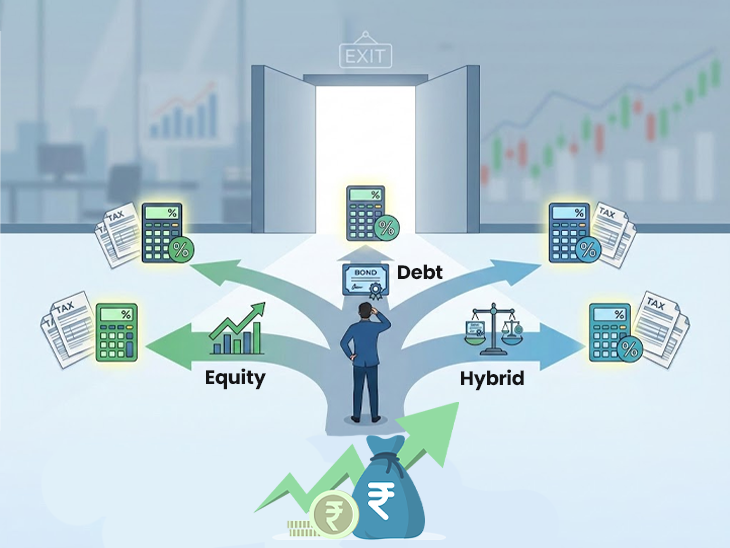
Debt mutual funds are investment vehicles that primarily allocate money to fixed-income securities like corporate bonds, government securities, and money market instruments. Switching between debt fund schemes is a common practice among Indian investors, aiming to optimize returns and diversify portfolios. However, this switching is not just a financial tactic—it has implications on your tax liability under debt fund taxation laws. In India, the amount of tax liability depends on factors like the holding period and the individual’s income tax slab.
Understanding how debt fund investments and switches affect taxes is crucial to managing finances effectively. Let us delve into the taxation rules relevant to debt fund switching and highlight how this impacts the investor’s bottom line.
Debt Fund Taxation Rules in India
Debt fund taxation depends on the holding period of the investment and is classified under two broad categories:
1. Short-Term Capital Gains (STCG)
If you sell or switch a debt fund within 36 months of purchasing it, the profit earned is considered a short-term capital gain (STCG). STCG from debt funds is added to your gross income and taxed per your income tax slab rates. For example:
– Income Tax Slabs (FY 2023-24 in India)
– Income up to ₹2,50,000: No tax
– ₹2,50,001 – ₹5,00,000: 5%
– ₹5,00,001 – ₹10,00,000: 20%
– ₹10,00,001 and above: 30%
Example Calculation:
Suppose an investor falls in the 20% income tax slab and earns a short-term capital gain of ₹50,000 by switching debt funds. The tax payable would be:
Tax = ₹50,000 × 20% = ₹10,000
Thus, STCG can significantly increase the tax liability based on your income tax slab.
2. Long-Term Capital Gains (LTCG)
If you sell or switch a debt fund after holding it for more than 36 months, the profit will be considered a long-term capital gain (LTCG). LTCG from debt mutual funds is taxed at 20% and extends the privilege of indexation benefits to lower the tax burden.
What is Indexation?
Indexation adjusts the purchase price of investments using the Cost Inflation Index (CII) to account for inflation, resulting in lower taxable gains.
Example Calculation:
Consider an investor who purchased debt funds worth ₹2,00,000 in April 2019. The funds are sold for ₹3,00,000 in March 2023. The CII for FY 2019-20 is 289, and CII for FY 2022-23 is 331. The indexed purchase price is calculated as:
Indexed Purchase Price = Original Price × (CII of Sale Year / CII of Purchase Year)
Indexed Purchase Price = ₹2,00,000 × (331 ÷ 289) = ₹2,28,347
LTCG = Sale Price – Indexed Purchase Price = ₹3,00,000 – ₹2,28,347 = ₹71,653
LTCG Tax = ₹71,653 × 20% = ₹14,330.60
Thus, while LTCG attracts a higher flat tax rate compared to STCG, the indexation benefit can offer a degree of relief.
Impact of Debt Fund Switching
When you switch from one debt mutual fund scheme to another, the tax implications are similar to selling a fund and investing in a new one. Switching is considered a “sale” transaction for tax purposes. To understand the impact of switching debt funds, consider the following scenarios:
Scenario 1: Switching Within 36 Months
If you switch debt mutual funds within 36 months, the gains from the switch are counted as STCG and taxed according to your income tax slab. This can result in substantial tax outflow, especially for investors in the higher tax brackets.
Calculation Example:
Investor’s Tax Slab: 30%
Initial Investment: ₹1,00,000
Value of Debt Fund upon Switch: ₹1,50,000
STCG = ₹1,50,000 – ₹1,00,000 = ₹50,000
Tax Liability = ₹50,000 × 30% = ₹15,000
Cost of switching: ₹15,000 (tax).
Scenario 2: Switching After 36 Months
If switching occurs after 36 months, the gains are treated as LTCG. The tax rate is lower (20%, with indexation benefits). However, calculating LTCG with indexation involves additional computation.
Calculation Example:
Investor purchases debt funds worth ₹1,00,000 (CII = 280) and switches to a new scheme after 4 years for ₹1,50,000 (CII = 330).
Indexed Purchase Price = ₹1,00,000 × (330 ÷ 280) = ₹1,17,857
LTCG = ₹1,50,000 – ₹1,17,857 = ₹32,143
Tax Liability = ₹32,143 × 20% = ₹6,428.60
Cost of switching: ₹6,428.60 (tax).
LTCG with indexation benefits is more tax-efficient, proving advantageous for investments held longer.
Additional Considerations
- Tax-Free Switches within NPS: Unlike other debt funds, switching investments within National Pension System (NPS) accounts does not attract tax liability.
- Exit Loads: Switching between debt funds may incur exit loads, which are additional charges levied by fund houses for early redemption.
- Impact on Overall Portfolio: Frequent switches can erode returns due to tax and transaction costs. A detailed assessment of the pros and cons is necessary before making decisions.
Disclaimer
The information provided here is meant for educational purposes only and should not be construed as financial advice. Investors must evaluate their goals, income tax slabs, and overall portfolio dynamics thoroughly before making decisions regarding debt fund investments and switches. It is recommended to seek advice from certified financial professionals to gauge the risks and benefits of trading in the Indian financial market.
Summary
Debt fund taxation in India depends on the holding period of the investment, with gains categorized as STCG or LTCG. Short-term capital gains from debt funds are taxed according to an individual’s income tax slab, while long-term capital gains attract a flat tax rate of 20% with indexation benefits. Switching between debt funds is treated as a sale transaction for tax purposes, impacting tax liability accordingly. For switches within 36 months, gains are taxed as STCG, which can result in a higher tax outflow, especially for individuals in higher tax brackets. On the other hand, switches after 36 months qualify for reduced tax liability due to indexation. Calculations show that the tax paid on LTCG is considerably lower than the tax on STCG when indexed costs are factored in. Investors should consider tax implications and other costs, such as exit loads, before making investment decisions. Proper planning and awareness of debt fund taxation can help navigate these scenarios effectively.