


The Shopify ecosystem is entering a new phase of maturity, defined less by new Shopify features in 2026 and more by its underlying architecture and data strategy. The conversation has shifted from “how do we launch faster?” to “how do we design an eCommerce system that can adapt continuously?” These changes place Shopify development squarely at the intersection of technology and revenue strategy, influencing everything – from user experience to how effectively products surface inside AI-driven discovery environments. In this context, Shopify trends to watch in 2026 are not isolated feature updates, but a broader evolution of the platform itself.

For merchants, this creates new opportunities to differentiate through speed and personalization. At the same time, for Shopify developers and Shopify development service providers, it raises the bar on development expertise and governance.
This article examines the Shopify development trends shaping 2026. We will explore how modern Shopify builds are responding to AI-led discovery, composable architectures, and privacy-first data strategies, and what these shifts mean for businesses investing in Shopify as a core revenue platform.
Table of Contents
Latest Shopify Trends to Watch in 2026
1. Rise of Agentic Storefronts
eCommerce is transitioning from reactive search bars to AI-driven Agentic Storefronts. While Agentic Commerce enables people to autonomously make purchases across the web, Agentic Storefronts allow customers to purchase products and check out directly in AI channels like ChatGPT, Google AI Mode, Gemini, and Microsoft Copilot.
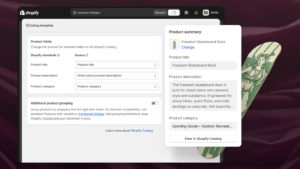

This 2026 Shopify trend brings major updates to its existing AI tools, including Sidekick Pulse (Merchant Advisor) and Shopify Magic (Customer Interaction Manager).
- Sidekick Pulse now serves as a proactive AI engine that continuously analyzes store signals and delivers real-time, actionable insights. For instance, it can identify a 5% drop in conversion for a specific SKU and automatically recommend a 10% flash sale to counter a competitor’s price drop.
- Shopify Magic AI optimizes in-session experiences by generating personalized product descriptions, email content, and customer segment descriptions. Leveraging LLMs, it ensures that the generated text matches your brand’s tone, creating consistent communication across customer interactions.
This level of AI-enhanced conversion rate optimization (CRO) ensures that high-intent content is prioritized, driving Average Order Value. The experience becomes friction-free, delivering a curated concierge service rather than a static catalog.
2. Composable and Serverless Shopify Development Trends 2026
2026 Shopify trends are reshaping how eCommerce stores are actually built. Two architectural shifts stand out above all others.
- One is the shift from Liquid-based monolithic themes to headless and composable stores.
- Another is replacing server-side scripts with serverless Functions.
The interesting thing is, they are not different but two sides of the same direction.
For years, merchants customized themes through Liquid templates. But Liquid has a hard ceiling. It is server-rendered and tightly coupled to Shopify’s theme engine, meaning every front-end customization is constrained by the back-end boundaries. But now, Shopify is moving away from tightly coupled code toward a serverless, API-driven architecture that lets Shopify developers customize more. This is achieved through headless Shopify development, done via Hydrogen and Oxygen—Shopify’s own stack.
- Hydrogen is a React-based headless commerce framework built on the open-source React Router framework. It is optimized for performance with features like Optimistic UI, nested routes, and progressive enhancement with pre-built components, hooks, and utilities all mapped directly to Shopify APIs.
- Oxygen is Shopify’s globally distributed hosting layer, deployable with a push-to-deploy workflow and included at no additional cost on qualifying Shopify plans.
Several studies highlighted that companies implementing headless commerce see tangible revenue growth driven by expanded product offerings and enhanced customer experiences. Brands like Sennheiser have demonstrated significant improvements in speed by opening 25 headless stores, reducing the time to open a new market to 8 weeks, and achieving a 4.5% increase in conversion rate.
It’s worth being honest about the tradeoff. Headless architecture requires a higher initial investment both in development costs and ongoing governance. Finding experienced Shopify developers proficient in headless commerce is harder than simply hiring for standard Liquid theme work.
Regardless of whether you go headless or stay on a Liquid theme, the Functions migration on June 30, 2026, is a hard stop due to the planned deprecation of Shopify Scripts. The brands treating it as a Q2 problem will be scrambling during peak trading periods. Starting the audit and migration now is the only rational plan.
3. LLM Optimization of your eCommerce Store
LLM Optimization, more commonly known in industry as Generative Engine Optimization (GEO), has emerged as a significant shift in how Shopify merchants approach product discoverability in 2026. Rather than focusing solely on traditional SEO, merchants now need to ensure their stores are visible and citable inside AI-powered tools like ChatGPT, Perplexity, and Google Gemini, where a growing share of product discovery is happening.
64% want AI-driven product discovery and personalised recommendations, making AI discoverability a top-of-funnel priority that sits alongside, not in place of, traditional SEO. This shift is being driven by the evolution of modern large language models such as GPT-5, Grok 4.1 DeepSeek V3.1, and Claude, which process the full context and intent behind a customer query rather than matching exact keywords. Shopify itself has built this logic into its infrastructure through its Global Catalogue using multimodal LLMs to continuously enrich and standardize product data at scale, making millions of merchants’ products understandable by machines.
For Shopify merchants, the goal is not higher keyword rankings, but being the recommended answer when a shopper asks an AI Agent a buying question.
Shopify also introduced MCP (Model Context Protocol) support in mid 2025 via the Dev MCP Server and Storefront MCP, enabling ChatGPT, Perplexity, Gemini, Claude, and other LLMs to query a store’s product catalog in real-time. Keeping product data well-structured through clean Metaobject schemas and Metafields is now a prerequisite for effective AI discoverability through these MCP-powered connections.
4. Mobile-First and “Thumb Zone” Design
If you are still focusing on desktop-first eCommerce stores, you need to understand that a major chunk of Shopify traffic comes from mobile devices. This shows that Shopify growth rate for high-performing brands is tied to how well they design and use the “Thumb Zone.”
For modern Gen Z consumers, physical comfort is the silent driver with a direct impact on Shopify conversion optimization. Research shows that 49% of users use a one-handed grip and 75% rely entirely on their thumb for navigation. Gen Z is the first generation to treat the mobile browser as an extension of their social feeds. They discover while scrolling. For this demographic, even a minor friction point like a tiny close button on a pop-up is enough to trigger an immediate bounce.
5. Multi-Channel Integration and Unified Data Sync
Modern customers are not confined to a single platform for shopping; they engage with brands through mobile apps, social media, websites, LLMs, and even physical stores. For Shopify merchants, integrating data across all these touchpoints ensures a consistent shopping experience. This approach aligns with Shopify trends in 2026, where creating a unified customer journey is essential to boosting conversion rates.
Shopify’s infrastructure enables real-time syncing of product data, inventory, pricing, and order statuses across multiple channels, ensuring customers receive consistent, accurate information no matter where they shop.
For example, with Shopify POS, a purchase made in a physical store instantly updates online stock and syncs customer profiles, including loyalty status and purchase history. Similarly, Shopify’s native channel integrations ensure that inventory updates are reflected across social commerce channels such as Instagram, TikTok, and Facebook. This reduces overselling and pricing inconsistencies, though the degree of real-time sync depends on channel configuration and the merchant’s Shopify plan.
6. Augmented Reality (AR) and 3D Product Visuals for Interactive Shopping
GenZ shoppers crave more interactive and intuitive experiences that bring products to life. To solve the long-standing issue of customers not being able to visualize products before purchasing, brands are using AR and 3D visuals. According to Shopify’s latest data, products featuring interactive 3D or AR content see a staggering 94% higher conversion rate than those relying solely on 2D photography.
For example, Gunner Kennels, a pet product manufacturer, used AR to help customers properly size their dog kennels. This resulted in a 40% increase in conversion rates and a 5% reduction in return rates, showing that AR works across industries by addressing purchase hesitation.
Shopify has been ahead of the curve in enabling merchants to deliver AR experiences. Shopify’s native AR capabilities work seamlessly with iOS using the .usdz format via AR Quick Look, with Android using the .glb format via Scene Viewer, and with websites adhering to WebXR standards in Safari/Chrome environments. The best part is that no third-party apps are required to implement basic AR experiences.
While AR has been available on Shopify since 2020, adoption remains relatively low and many merchants have not fully implemented AR or 3D visualizations on their Shopify stores. Those who invest now, particularly in well-executed AR experiences, are still early movers in many niches.
7. Deep Rooted Personalization
The data infrastructure that eCommerce ran on for a decade is gone. Third-party cookies have been deprecated, platform data-sharing has contracted, and privacy regulations across the EU, US, and Asia-Pacific continue to tighten.
The brands responding correctly are treating it as an infrastructure problem, and the infrastructure they are building is centered on first-party, user-generated data, with 78% of brands now considering it their most valuable source for personalization. And this trajectory is not slowing down in 2026.
Before addressing the collection strategy, it is worth establishing why the urgency has sharpened in 2026. According to McKinsey, half of all consumers now use AI-powered search as their primary tool for product research and purchase decisions. The company projects that $750 billion in consumer revenue (in the US alone) will flow through AI-powered search channels by 2028, and that brands unprepared for this shift could lose 20 to 50% of their traditional organic traffic as a result.
That means the customer’s awareness and consideration journey largely takes place off-platform. By the time a customer lands on a Shopify store, a purchase decision may already be substantially formed.
First-party data, such as purchase history, on-site behavioral tracking, email and SMS opt-ins, and post-purchase surveys, deliver the highest-quality data that forms the basis of personalization. This, when combined with conversion-focused interactive quizzes and loyalty programs, provides the customer intelligence depth that was previously accessible only to enterprises with dedicated CDP infrastructure and data science teams.
For Shopify developers, this requires implementing Shopify Web Pixels for consent-aware behavioral event tracking, the Customer API to provide a unified data layer, and Shopify Flow to automate recommendations or loyalty programs.
8. Creating Multiple Customer Touchpoints
GenZ customers rarely buy from a brand the first time they encounter it. They discover it through an Instagram or TikTok creator, research it with an AI tool, browse the storefront on mobile during a commute, abandon the cart, receive a retargeted email, and finally purchase 3 days later through Shop Pay one-tap checkout.
That is not an edge case in 2026, but the standard purchase journey. The typical buyer now interacts with up to 50 touchpoints, both online and offline, before checkout. The brand that controls more of those touchpoints converts more customers, retains them longer, and extracts significantly more CTLV from every acquisition dollar spent.
The commercial case for investing in multi-touchpoint architecture is equally unambiguous. Omnichannel shoppers spend 1.5 times as much as single-channel customers, and organizations with strong omnichannel strategies retain approximately 89% of their customers.
The Shop App is one such discovery touchpoint that deserves more deliberate investment than most merchants give it. It is a zero-cost owned channel that reaches existing and potential customers without competing in the paid advertising auction. By using its native AI-powered ‘Shop Minis‘ and personalized product recommendations, brands can maintain a persistent presence on a customer’s device long after the initial site visit. This is done through push notifications, emailers, or on-screen widgets. Moreover, when users track their orders within the App, they’re unintentionally pinned to the feed.
Shop Pay one-tap checkout is another highest-impact touchpoint. For returning Shop Pay users, the entire checkout flow is pre-filled and complete in a single tap. Beyond speed, the breadth of payment methods has become a direct conversion variable at both the demographic and geographic levels.
Final Words
In 2026, the difference between basic storefronts and those that’ll survive the evolving user preferences lies in how they absorb high-performance engineering and AI-powered features. The rise of native AI orchestration, the deprecation of Shopify scripts, and the demand for sub-second global latency have forced a pivot away from “template-first” thinking toward a data-backed, professional-led development strategy. And LC/NC website builders are not equipped for the same.
For merchants, future-proofing infrastructure requires embracing these Shopify trends in 2026 and treating them as the foundation for years to come. The brands that will lead the next decade are those currently dismantling legacy bottlenecks and making room for decentralized, agentic storefronts.
Author Bio :
Nathan Smith is a Technical Writer at TechnoScore with extensive knowledge in software documentation, API guides, and user experience. Mastering HTML, CSS, JavaScript, and tools like JIRA and Confluence, Nathan’s expertise covers Application Development, Software Engineering, AI/ML, QA Testing, Cloud Management, DevOps, and Staff Augmentation (Hire mobile app developers, hire WordPress developers, and hire full stack developers etc.).