


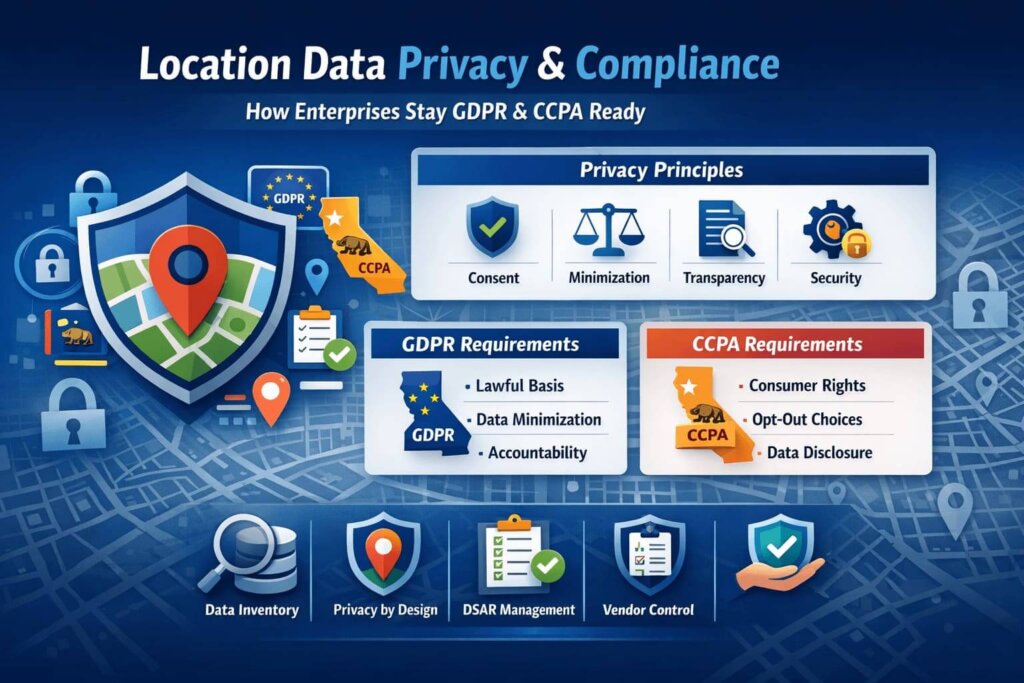
One of the most valuable modern enterprise inputs is location data: expanding stores, optimizing delivery, stopping fraud, football analytics, and competitive intelligence. It is also one of the most sensitive data types that can be processed. Although it may not seem to be considered as such at first sight, location trails can easily be identified when paired with device IDs, timestamps, and behavioral patterns.
When your teams gather, purchase, enhance, or process location signs in apps, web sites, Internet of Things, maps, or third-party data, you require a privacy and conformity policy that scales without decelerating product, analytics and expansion.
This guide consists of a breakdown of what it practically, operationally, and repeatedly means to be GDPR and CCPA ready as an enterprise.
Table of Contents
Why location data is high-risk (and high-reward)
Location data is uniquely sensitive because:
- It’s granular (GPS-level precision can reveal home/work routines).
- Its persistent (longitudinal trails create a behavioral fingerprint).
- It’s easy to re-identify (even “anonymous” location points can link back to individuals with a few data joins).
That’s why regulators and privacy teams treat it as a “high impact” category often requiring stronger justification, safeguards, and documentation compared to standard analytics data.
GDPR (or CCPA): What business needs to pay attention to.
GDPR (EU/UK)– “Legal basis + protection + responsibility.
GDPR expects you to prove:
- Legitimacy of the processing (consent, contract, legitimate interests, and so on).
- Data minimization and purpose limitation
- Security and privacy by design
- Accountability (policies, records, DPIAs, vendor controls)
Location data commonly falls under personal data when it relates to an identifiable person directly or indirectly.
CCPA/CPRA (California) — “Consumer rights + disclosure + control”
CCPA/CPRA focuses on:
- Notice (what you collect, why, with whom you share/sell)
- Consumer rights (access, deletion, correction, opt-out)
- Data sharing controls (especially around “sale” or “sharing” for advertising)
- Reasonable security and vendor requirements
Practically, businesses converge on one operating model: transparency, consent/choice, minimization, governance, and powerful vendor management.
The enterprise compliance blueprint for location data
1) Build a “Location Data Inventory” you can trust
Most compliance gaps happen because no one has a complete view of:
- what location fields exist,
- where they come from,
- where they flow,
- and who can access them.
Your inventory should cover:
- Collection sources: mobile SDKs, web trackers, POS, Wi-Fi beacons, delivery apps, telematics, third-party datasets
- Data elements: lat/long, geohash, IP-derived location, check-ins, POI visits, movement trails, timestamps, device/user identifiers
- Processing purposes: analytics, personalization, fraud, operations, advertising, research, competitive intel
- Storage and access: warehouses, lakes, BI tools, downstream exports, contractors, agencies
- Retention: how long each dataset is kept and why
Enterprise tip: Treat this as a living system not a one-time spreadsheet. Tie it to your data catalog, tagging, and access controls.
2) Define lawful basis and “purpose boundaries”
For GDPR, location processing must match a lawful basis. Many enterprises try to default to “legitimate interests,” but location often triggers stronger expectations. In many consumer scenarios (especially precise GPS), consent or explicit choice controls are the safest approach.
Set purpose boundaries that are easy to audit:
- What is allowed for product ops (delivery ETAs, service coverage)?
- What is allowed for security/fraud?
- What is allowed for analytics (aggregated, delayed, de-identified)?
- What is allowed for marketing/ads (opt-out/opt-in rules)?
If a team wants a new use case, they should go through a simple workflow:
request → privacy review → DPIA (if needed) → approvals → implementation guardrails.
3) Apply data minimization (precision, frequency, and retention)
Minimization for location isn’t only “collect less.” It’s also:
- Less precise (city-level instead of GPS when possible)
- Less frequent (batch sampling vs continuous tracking)
- Less linkable (remove persistent IDs or isolate mapping keys)
- Shorter retention (keep raw trails briefly, store aggregates longer)
A strong model looks like:
- Raw GPS points: kept for the shortest needed window (e.g., operational troubleshooting)
- Processed/filtered events: kept for analytics with reduced precision
- Aggregated insights: kept longer with low re-identification risk (heatmaps, trends, POI-level counts)
4) Privacy-by-design for location pipelines
Enterprises that stay compliant design privacy into the pipeline, not into the policy doc.
Key controls include:
- Pseudonymization: separate identity data from location trails; protect re-link keys
- Aggregation & k-anonymity thresholds: don’t surface “small group” location patterns
- Geo-fencing sensitive places: hospitals, schools, places of worship block or heavily aggregate
- Role-based access controls (RBAC): only grant location access to teams who truly need it
- Audit logs: who accessed what, when, and for what purpose
5) Make DSAR (data subject rights) operational
Under GDPR and CCPA, individuals can request:
- access to their data,
- deletion,
- correction (CPRA),
- portability (GDPR),
- opt-out (CCPA/CPRA).
If you collect , DSAR gets harder because it often lives across multiple systems and vendors.
An enterprise-ready DSAR model includes:
- Identity verification + request intake
- A data map to locate all related records (including vendor platforms)
- A workflow for extraction/deletion within mandated timelines
- Rules for exceptions (fraud/security retention) with documented justification
- A standard response format and audit trail
6) Vendor and third-party dataset governance
A major risk area is buying or using third-party location datasets, SDKs, or enrichment providers.
Before onboarding any vendor that touches location data, validate:
- Data provenance: how was it collected? Was consent obtained? Is it resold?
- Contract terms: DPAs, SCCs (if cross-border), subprocessors, breach notification, audit rights
- Use restrictions: no secondary use beyond your defined purpose
- Security posture: encryption, access controls, monitoring, certifications
- Deletion + retention commitments
If you can’t explain your dataset origin confidently, you’re carrying legal and reputational risk.
7) Cross-border transfers and storage controls
If location data moves across regions (EU → US, etc.), you need:
- a transfer mechanism (often SCCs),
- vendor diligence,
- and safeguards such as encryption, minimization, and access restrictions.
Enterprises reduce transfer complexity by:
- regionalizing storage where feasible,
- keeping identity keys local,
- and sharing only aggregated outputs across regions.
Key Features
- Privacy-by-design location pipelines: Minimize precision, isolate identifiers, and aggregate insights to reduce re-identification risk.
- Audit-ready governance: Maintain a living data inventory, lawful basis mapping, and access logs across all systems.
- Operational DSAR workflows: Automate access, deletion, and opt-out requests across internal tools and vendors.
Common enterprise mistakes (and how to avoid them)
Mistake 1: “It’s anonymous, so we’re safe.”
Location data is often re-identifiable. Fix it with aggregation, minimization, and strict join controls.
Mistake 2: No one owns location governance.
Assign clear ownership across Privacy, Security, Data, and Product. Create a single playbook.
Mistake 3: Vendors become the blind spot.
Treat SDKs and third-party datasets as first-class compliance scope. Validate provenance and contract restrictions.
Mistake 4: DSAR is handled manually.
Manual DSAR breaks at scale. Build repeatable workflows and connect them to your data map.
A practical “GDPR & CCPA ready” checklist for location data
- Location data inventory (retention, flows, fields, sources)
- Legal grounds allocated to every use case (GDPR).
- Transparency controls (CCPA/CPRA + GDPR transparency)
- Minimization: precision, frequency, retention, linkability
- Pseudonymization and separation of identity keys
- RBAC + audit logs for sensitive datasets
- Aggregation thresholds and sensitive-place filtering
- DSAR workflows connected to systems + vendors
- Vendor diligence, DPAs, subprocessors, provenance validation
- Cross-border transfer safeguards (where applicable)
- Incident response plan for location datasets