


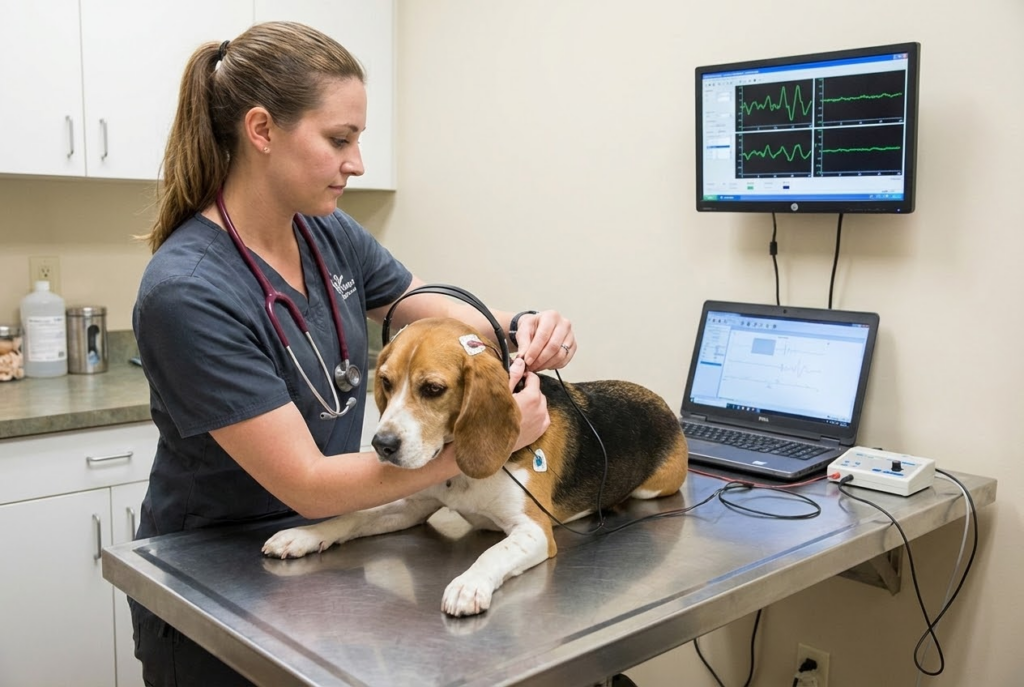
Hearing problems in dogs are not always obvious, which is why many breeders and veterinarians rely on the to evaluate auditory function accurately. Unlike simple clapping or noise tests at home, BAER testing for dogs provides an objective measurement of how well sound signals travel from the ear to the brain. This makes it a key tool for screening puppies, confirming suspected deafness, and making informed breeding and care decisions.
Understanding the BAER Hearing Test
BAER stands for Brainstem Auditory Evoked Response, a specialized dog deafness test that records the brain’s electrical activity in response to sound. During a baer hearing test for dogs, small electrodes are placed on the animal’s head and sounds are delivered through ear inserts or headphones. The resulting waveforms show whether the auditory pathway is functioning normally.
Because BAER measures responses within the nervous system itself, it is far more reliable than behavioral observations alone, especially in very young or uncooperative animals.
When Is BAER Testing Recommended?
There are several common situations where a BAER test for dogs is particularly helpful:
- Screening puppies from breeds known to be at higher risk of congenital deafness.
- Evaluating dogs with suspected unilateral (one-sided) or bilateral (both ears) hearing loss.
- Assessing hearing in animals with chronic ear disease or after treatment for severe infections.
- Providing documentation for breeders and new owners about a pup’s hearing status.
In these cases, BAER testing for dogs can clarify whether hearing is normal, partially reduced, or absent, even if the dog appears to respond inconsistently to sounds at home.
What Happens During a BAER Hearing Test?
The baer hearing test for dogs is minimally invasive and usually well tolerated. The typical procedure involves:
- Light sedation in some dogs to keep them calm and still, especially in puppies or anxious pets.
- Gentle clipping and cleaning of small areas on the head where electrodes will be attached.
- Placement of earphones or inserts that deliver a series of clicks or tones.
- Recording of the brain’s responses over a short period, often just a few minutes per ear.
Most dogs recover quickly from sedation and can go home the same day, with results interpreted by clinicians experienced in reading BAER waveforms.
Interpreting BAER Test Results
BAER results show characteristic waves that correspond to different points along the auditory pathway. A normal tracing indicates that sound signals are traveling from the ear to the brainstem as expected. Absent or abnormal waves suggest partial or complete deafness in one or both ears.
These findings help veterinarians and owners:
- Confirm whether a dog is truly deaf or simply unresponsive to certain sounds.
- Distinguish between unilateral and bilateral hearing loss.
- Decide whether a dog should be used in breeding programs, especially in breeds with inherited deafness.
By using an objective dog deafness test, breeders can make more responsible decisions and reduce the incidence of hereditary hearing problems.
Benefits for Puppies, Owners, and Breeders
For breeders, offering BAER testing for dogs demonstrates a commitment to health screening and transparency. Puppy buyers gain confidence knowing that their new companion’s hearing has been evaluated by a reliable method. Owners of adult dogs with behavior or training issues can also benefit from BAER testing, as undiagnosed deafness is sometimes mistaken for stubbornness or anxiety.
Early identification of hearing impairment allows families to adapt training methods, use visual cues, and create safe environments tailored to the dog’s needs.
Conclusion: A Clear Picture of Canine Hearing
The baer test for dogs is a valuable, objective tool for assessing hearing in puppies and adult dogs alike. By using this specialized baer hearing test for dogs, veterinarians, breeders, and owners can accurately diagnose deafness, guide breeding decisions, and adjust training strategies. When questions about hearing arise, a formal dog deafness test provides clarity and supports better long‑term outcomes for canine companions.