


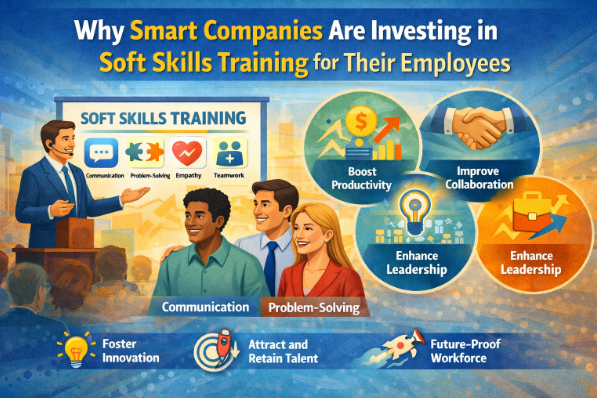
A place of work full of technically skilled employees is wonderful to hear until the employees discover that they are unable to collaborate, communicate, or manage stress effectively. Their technical skills help them to get hired, but the actual success of the employees depends on their soft skills. Companies that want to have a more cohesive team, better employee retention, and healthy workplace culture now need soft skills training for employees. It is also an intentional investment whose returns can directly affect performance and people.
-
It Transforms Workplace Communication from Ordinary to Exceptional
Quality communication within the entire organization is greatly enhanced when staff members are trained on soft skills. The instructions are much clearer, misunderstandings are reduced, and the feedback is considered more carefully and precisely. The teams start exchanging ideas more freely and stop working as silos. Trained employees are able to have confidence in themselves and the language to speak up, ask relevant questions, and keep the team in line, which eventually reduces costly errors in addition to results in a much more unified and productive workplace.
-
It Builds Emotional Strength That Handles Workplace Pressure
All the jobs have deadline, are hard to manage, and full of unpredictable challenges. Workers who lack emotional intelligence will be volatile when stressed or lead to conflict in the group. Trained employees on soft skills are in a better position to recognize their feelings and professionalize their behaviours and stay solution-oriented in stressful circumstances. This emotional strength is beneficial to the entire team and not an individual. A mature stress managing staff will deliver results even in the most challenging circumstances.
-
It Creates a Culture Where People Actually Want to Stay
For any organization, a high staff turnover rate is costly and draining. Feeling underappreciated, ignored, or cut off from their colleagues is one of the least talked-about reasons individuals quit their professions. The soft skills training modules contribute to the development of an environment at work that values empathy, and respect, as well as constructive dialogue. Loyalty comes easily when workers feel truly understood and supported. People opt to grow rather than depart when managers and employees are trained to interact with better emotional awareness.
-
It Sharpens Team Collaboration and Removes Hidden Friction
When cooperation fails, even the most skilled teams may perform poorly. Underdeveloped soft skills are indicated by personality conflicts, ambiguous role boundaries, and passive resistance. Employees learn through training how to resolve conflicts, divide duties equitably, and help one another through difficult times. Friction is greatly reduced when people are able to collaborate with a variety of personalities and communication styles. Teams begin to move more quickly, and think more creatively, along with producing outcomes that would be impossible for a person to do on their own.
Conclusion
Every employee, regardless of rank, truly benefits from soft skills training; it is not a luxury exclusive to top leadership. Stronger teams, and healthier cultures, as well as more consistent performance are all observed in organizations that place a high priority on this training. Everything in the workplace just functions better when individuals have the appropriate interpersonal tools. Investing in the soft skills online courses is ultimately an investment in the long-term stability and success of your entire organization.